



The rolls royce phantom sound system comes up first when we ask someone about this car model. Because it is one of the clearest examples of how the car was engineered. Most luxury vehicles add audio equipment after the cabin design is finalized, treating it as an accessory rather than a core feature. Rolls-Royce reversed that order: sound was part of the engineering brief from day one, alongside insulation, structure, and ride comfort. This approach makes the cabin and audio system work together to deliver a more immersive listening experience.
A great speaker placed in a noisy, insulated cabin will always sound average. However, Rolls-Royce knew this early on, and the true definition of premium car audio is not just the audio but the quiet. To stop road noise, wind, and mechanical vibration from reaching the listener's ear, the cabin's doors, floor, and roof are lined with layers of sound-deadening material in the Phantom. This is the same principle used in a quiet room when it comes to hearing a whisper; if you can hear less noise around you, even less significant equipment will sound better.
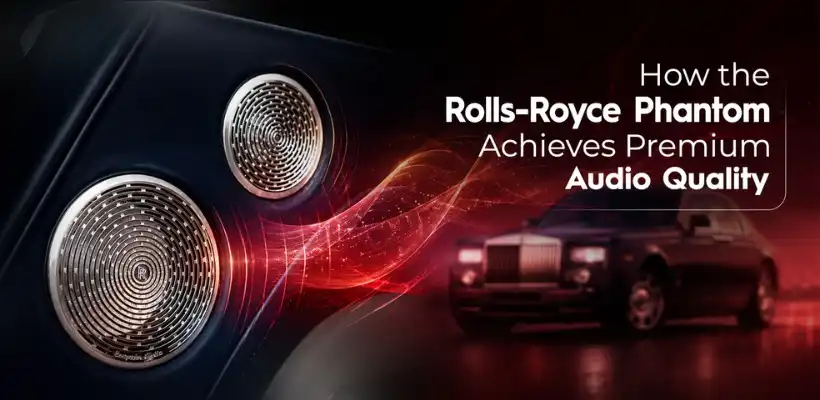
After the cabin control settles, the speaker's performance determines the audio quality. In addition to numerous individually positioned speakers and exciters around the cabin, including within the doors and headliner, Phantom's sound comes from many different directions as well as from the dashboard. It's important because, when positioned correctly, it encourages the brain to "locate" the sound source, simulating a live event. The system can provide depth and instrument separation, the difference between hearing and feeling music, when it spreads among a wide range of tuned points.
The idea with the majority of upgraded car audio systems is to improve your system with more power, larger subwoofers, louder amplifiers, and even more bass. The Phantom goes in a different direction, since in a car this quiet, raw volume isn't the point. Rather than accuracy, it is more about achieving consistency where a vocal track is played in the car as it would be played on studio monitors. It takes some very careful tuning to get the frequency response just right to make sure that at any volume, you hear the whole range of frequencies properly, without one band dominating the others as the volume is turned up. This is how the same amount of volume of the same song can sound lifeless in one car and rich and layered in another Phantom.
However, electronics is not the only factor in a speaker's performance; the physical parts are important too. A lower-priced speaker may bend slightly during heavy bass passages, causing distortion that you may not be aware of, but that will certainly impact the "clean" sound. To stop that flex, the Phantom's audio components are specifically made with rigid materials and reinforced housings to confirm the sound source remains stable throughout intense tracks. It's the same reason that premium in-car audio is better than standard factory audio: not only is there more equipment installed, but it's installed in a way that's more resistant to the unavoidable distortions that occur at higher volumes.
There's an easy way to read about the number of speakers and assume that more equals better, but it's the way all of the factors are combined that really counts. Cabin insulation eliminates interference, speaker placement improves depth, tuning is balanced for accuracy, and materials are reinforced for accuracy when applied. Once you've removed one piece, the others simply cannot make up for it. That’s why aftermarket audio upgrades alone, without improving cabin noise control or speaker placement, often fail to deliver the same level of sound quality.
When it comes to upgrading the audio system in a Rolls-Royce Phantom, results depend on more than just replacing or adding new speakers. The audio quality is built on a complete system that includes cabin insulation, speaker positioning, tuning, and material design, all working together as one engineered unit.
Because of this, simple speaker upgrades alone may not deliver the expected improvement. Without matching the cabin acoustics and factory-level tuning, the overall sound balance can easily be affected. It clearly shows that the true hallmark of in-car audio quality comes from meticulous design and engineering, with every element carefully crafted to deliver the best possible listening and listening experience.